Morocco
Marrakech
7 landmarks2 UNESCO
The Red City — ancient medina souks, ornate palaces, the Koutoubia minaret, and the intoxicating spectacle of Djemaa el-Fna at dusk.
Landmarks
0 / 7 visited
 Must-seeUNESCOLocal Icon
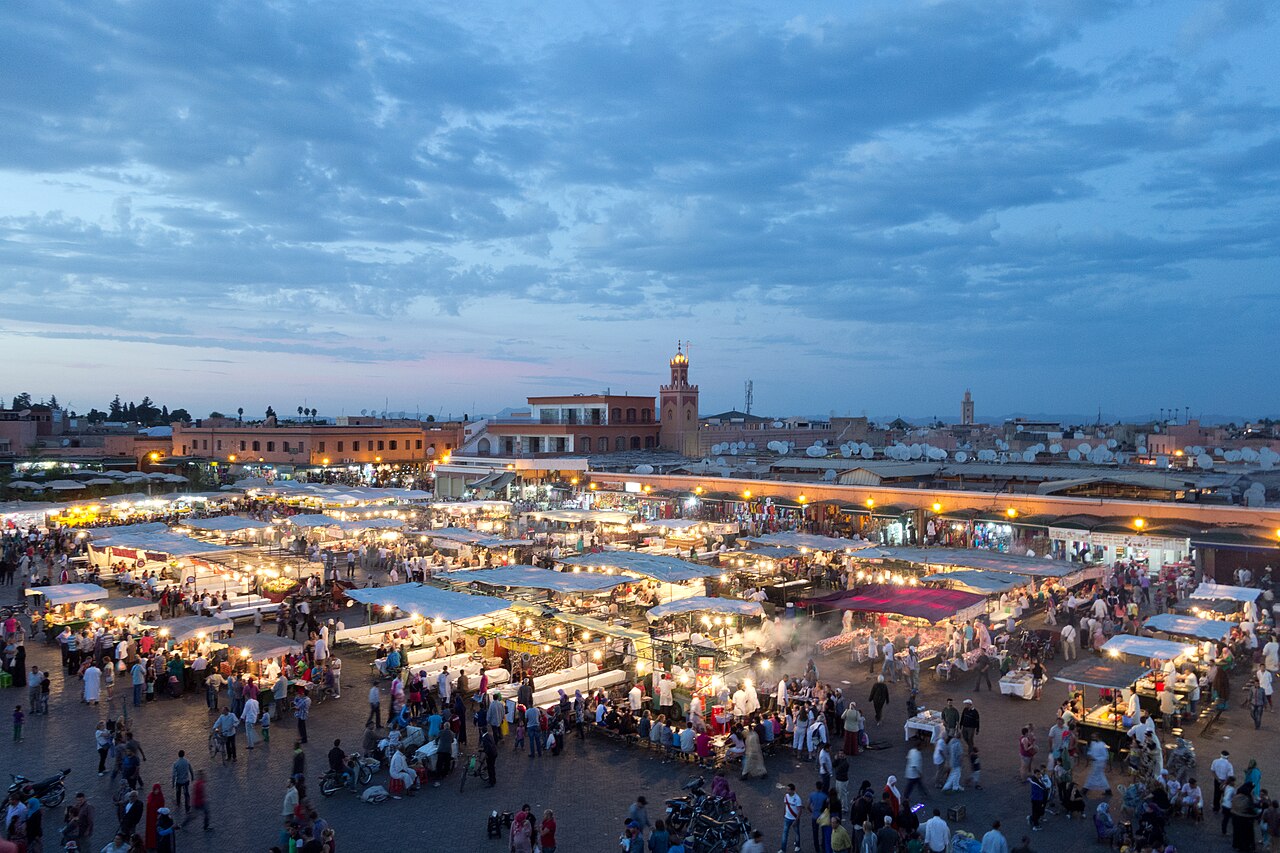
Djemaa el-Fna
The pulsing heart of Marrakech — a vast market square that transforms from a daytime fruit and food market into a nightly carnival of snake charmers, storytellers, acrobats, musicians, and food stalls. UNESCO recognized Djemaa el-Fna as an Intangible Cultural Heritage of Humanity. Watching the sun set over this spectacle is unforgettable.
 Must-seeUNESCOWorld Heritage
Medina of Marrakech
The ancient walled city of Marrakech, a UNESCO World Heritage Site since 1985. Founded in 1062 CE, the medina is a dense maze of souks (markets), riads (courtyard houses), mosques, and traditional workshops largely unchanged for centuries. Getting lost in its leather tanneries, spice markets, and coppersmith quarters is the quintessential Marrakech experience.
 Must-seeReligious Site
Koutoubia Mosque
Built in the 12th century by the Almohad dynasty, the Koutoubia Mosque is the largest mosque in Marrakech and one of the finest examples of Moorish architecture in the world. Its 70-meter minaret, visible from miles away, became the model for the Giralda in Seville and the Hassan Tower in Rabat.
 Scenic View
Majorelle Garden
Created by French painter Jacques Majorelle in 1924 and later purchased and restored by Yves Saint Laurent, Majorelle Garden is one of Morocco's most visited attractions. The garden's striking cobalt blue villa, exotic cactus collection, and tranquil reflecting pools make it an extraordinary oasis in the medina.
 Historical Architecture
Bahia Palace
Built in the 1890s for a powerful vizier, the Bahia Palace ('Palace of the Beautiful') is a stunning example of late 19th-century Moroccan and Andalusian architecture. Its ornate rooms feature intricate zellige tile floors, carved cedarwood ceilings, and lush courtyard gardens.
 Historical Architecture
Ben Youssef Madrasa
North Africa's largest Islamic theological college, dating to the 14th century and expanded by the Saadian dynasty in 1565. The inner courtyard is considered one of the finest architectural spaces in the Islamic world — carved stucco panels, geometric cedar mashrabiya screens, and a magnificent central pool reflect the complex's extraordinary ornamentation.
 Historical Architecture
Saadian Tombs
The royal mausoleums of the Saadian dynasty, built in the late 16th century. Walled off for 200 years by a later sultan and only rediscovered in 1917, the tombs contain 66 rulers and royals in three elaborately decorated chambers of Italian Carrara marble, gilded cedarwood, and zellige tilework.