Uzbekistan
Samarkand
7 landmarks4 UNESCO
The crossroads of the Silk Road — Timurid architecture, turquoise domes, and one of the world's oldest cities.
Landmarks
0 / 7 visited
 Must-seeUNESCOWorld Heritage
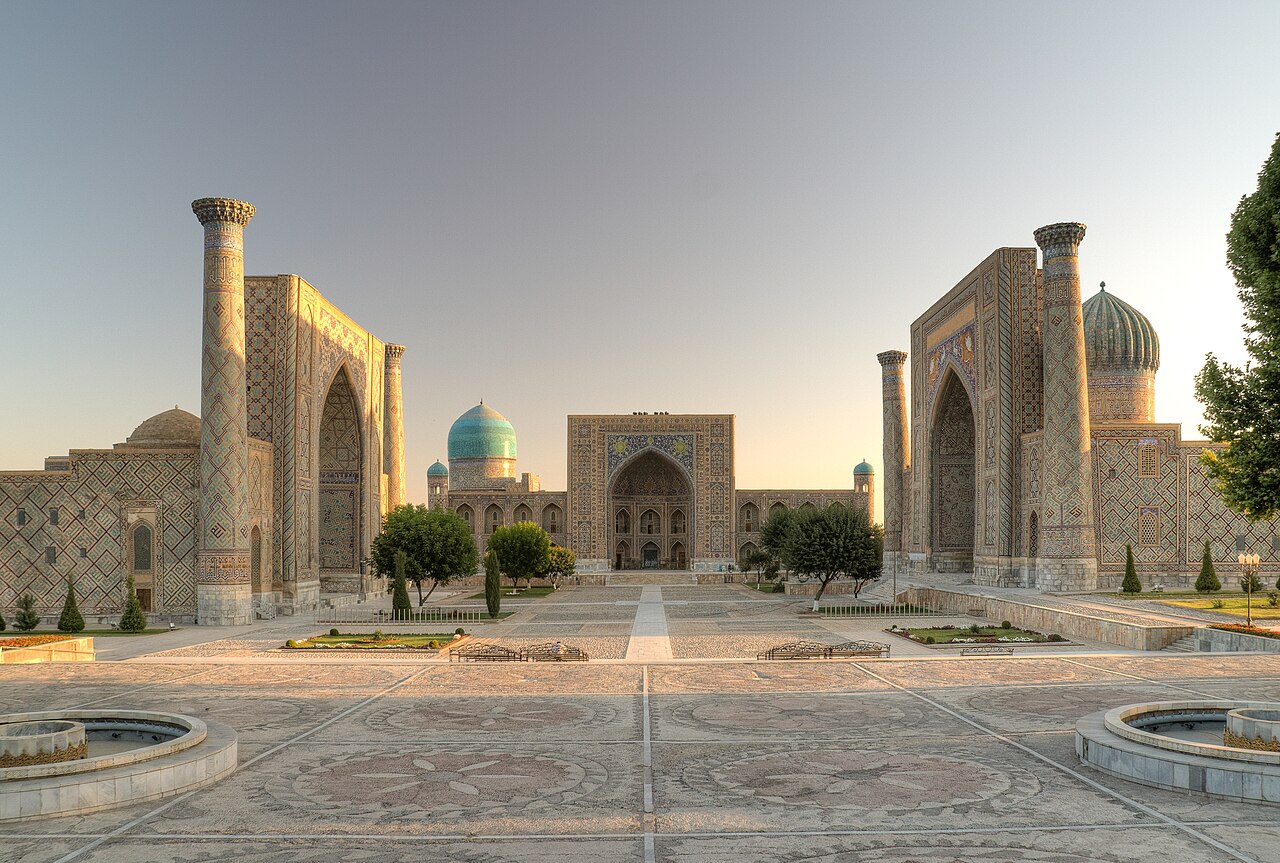
Registan
Three monumental madrasahs surrounding a central square — the heart of Samarkand and the greatest architectural ensemble of the Timurid Renaissance. Built 15th–17th century.
 Must-seeUNESCOWorld Heritage
Shah-i-Zinda
A necropolis of stunning mausoleums with some of the finest tilework in the Islamic world. The name means 'The Living King' — a legend that a cousin of the Prophet is buried here, still alive.
 Must-seeUNESCOWorld Heritage
Gur-e-Amir
The mausoleum of Tamerlane (Timur), who conquered from Turkey to India. Its fluted turquoise dome inspired the Mughal tombs of India — including the Taj Mahal.
 UNESCOWorld Heritage
Bibi-Khanym Mosque
Built by Tamerlane in 1404 to be the greatest mosque in the Islamic world. So ambitious in scale that it began collapsing almost immediately — now masterfully restored.
 Historical Architecture
Ulugbek Observatory
Built in 1420 by astronomer-sultan Ulugbek, this observatory produced star catalogues accurate to within seconds — predating modern telescopes. One of the greatest scientific achievements of the medieval world.
 Museum
Afrasiab Museum
Built on the ruins of ancient Afrasiab — a city 2,500 years old. The museum's centerpiece is the spectacular 7th-century Sogdian frescoes, showing ambassadors from China, India, and Korea.
 Local Icon
Siab Bazaar
Samarkand's oldest and largest bazaar, in continuous operation for centuries. Famous for non bread (baked in clay ovens), dried fruits, spices, and the sounds of the ancient Silk Road.