Czech Republic
Prague
7 landmarks5 UNESCO
The City of a Hundred Spires — a perfectly preserved medieval city of Gothic cathedrals, Baroque palaces, Art Nouveau cafes, and the enchanting Charles Bridge.
Landmarks
0 / 7 visited
 Must-seeUNESCOWorld Heritage
Prague Castle
The world's largest ancient castle complex, covering over 70,000 square meters. Founded in the 9th century, Prague Castle has served as the seat of Bohemian kings and Czech presidents and dominates the city from its hilltop above the Vltava. UNESCO World Heritage Site. Contains St. Vitus Cathedral, Old Royal Palace, and Golden Lane.
 Must-seeUNESCOWorld Heritage
Charles Bridge
Prague's iconic 14th-century stone bridge, built in 1357 under Charles IV and lined with 30 Baroque statues of saints. For 400 years it was the only crossing over the Vltava, making it the busiest bridge in Central Europe. Walking Charles Bridge at dawn — before the crowds — is one of Europe's most magical experiences.
 Must-seeUNESCOWorld Heritage
Old Town Square
The heart of Prague since the 12th century — a stunning square surrounded by Gothic and Baroque architecture, dominated by the Church of Our Lady before Týn. At its center stands the Astronomical Clock (Orloj), installed in 1410 and still performing its hourly show of mechanical figures — one of the oldest working astronomical clocks in the world.
 Must-seeUNESCOHistorical Architecture
St. Vitus Cathedral
The spiritual and political heart of Czech statehood — construction began in 1344 but the cathedral was only completed in 1929, nearly 600 years later. Home to the Bohemian Crown Jewels, the tomb of Saint Václav (Wenceslas), and extraordinary Art Nouveau stained-glass windows designed by Alfons Mucha.
 UNESCOWorld Heritage
Josefov (Jewish Quarter)
One of the best-preserved Jewish quarters in Europe, with six historic synagogues and the medieval Old Jewish Cemetery — where layers of graves are stacked 12 deep. The quarter dates to the 13th century and survived the Nazi occupation, preserved as a 'museum of an extinct race'. UNESCO World Heritage Site.
 City Landmark
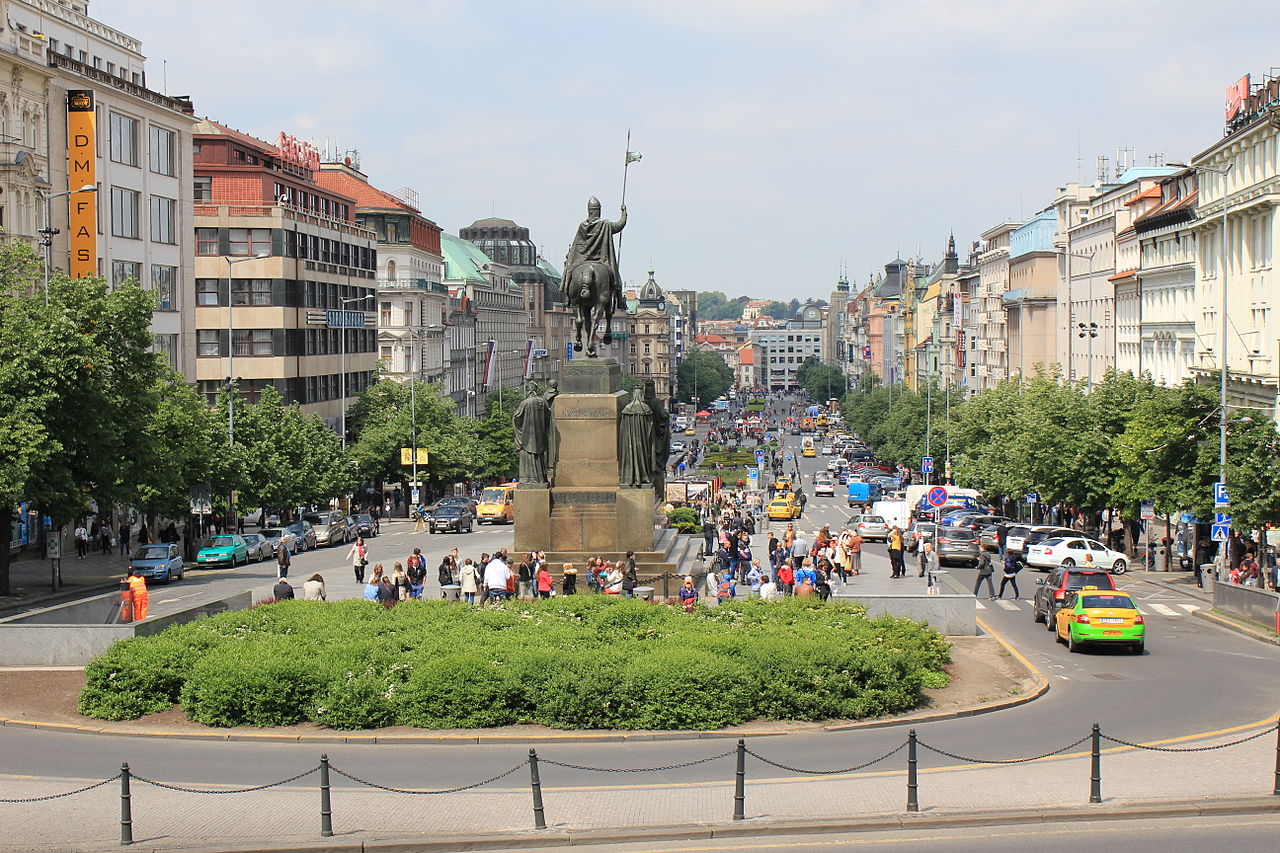
Wenceslas Square
Prague's main commercial boulevard and the site of pivotal moments in Czech history — the 1918 declaration of independence, the Prague Spring of 1968, and the Velvet Revolution of 1989. Dominated by the National Museum and the equestrian statue of Saint Wenceslas, it is both a shopping street and a monument to Czech nationhood.
 Scenic View
Petřín Hill & Lookout Tower
A forested hill rising above Malá Strana, topped by a 60-meter lookout tower (a mini Eiffel Tower built in 1891) and connected to the city by a funicular railway. Petřín's orchards and gardens offer the best views of Prague's red rooftops, and are among the city's most peaceful escapes.